Amid the debate on withdrawal of the stimulus, including speculation of a possible across-the-board roll back of cuts in excise duty and service tax, the document suggested further reduction in excise for export oriented industries.

'Mamata needs to address the anger and resentment among various sections of the Hindu community because low-scale communal violence has always paid richer electoral dividends for the BJP.'
.jpg)
The right sequence would be to gradually reduce SLR

Inflation stood at at a high of 8.23 per cent in January. After touching a high of 18.23 per cent in December, food inflation came down to 11.49 per cent in mid-February.

Finance Minister Nirmala Sitharaman on Tuesday said the securities transaction tax (STT) will be increased on futures and options (F&O) trade from October 1 to discourage retail investors from investing in the risky instrument.

The pre-Budget document on health of the economy stated that telecom, power, coal, ports, civil aviation and roads have shown signs of recovery in 2009-10.

... if high oil prices persist or stock prices correct sharply.

The Indian economy could remain less affected by global trade wars than other countries because the two engines of domestic growth - consumption and investment - are likely to face a limited impact from such headwinds, according to an article on the 'State of the Economy' in the Reserve Bank of India's (RBI's) bulletin, released on Tuesday.

In the current fiscal so far, retail inflation stabilised around 5 per cent, while wholesale price-based inflation averaged around 2.9 per cent during April-December.

Union Finance Minister Nirmala Sitharaman, along with her team of bureaucrats, delved into the fine print of the 2024-25 Budget documents in a press conference, detailing the government's road map on bringing down the debt-to-GDP ratio and bold tax measures.

Referring to the impact of political turmoil in West Asia, he said the crisis would not hurt the economy unless the crude oil prices rise to 'abnormally' high levels.

With the Bihar government releasing the findings of its caste survey, pressure seems to be mounting on the Karnataka government, especially within the ruling Congress, to make the state's Socio-economic and Educational Census, popularly known as the 'caste census', public.

The move is likely to encourage service providers to take their broadband services to rural India. To further increase connectivity, it recommended allowing open access to local loop for broadband provision and designate rural fibre-optic network as a 'public carrier' for provision of telecom connectivity in the rural areas.

'The long term strategy is that this government wants to create a second class citizen list.'
The government on Thursday said that any slowdown in the excess capital flows from the last year's high levels could affect the stock market in short-term, even as it would make the monetary management easier.
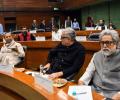
India's Parliament is set to begin its Budget session on Friday, with opposition parties poised to demand a discussion on the alleged mismanagement of the Maha Kumbh festival in Prayagraj, where 30 pilgrims died in a stampede. The opposition also accused the government of politicising parliamentary committees and pushing its agenda through its majority. The session will start with President Droupadi Murmu addressing both houses of Parliament. Finance Minister Nirmala Sitharaman will present the Union Budget on Saturday for the eighth consecutive time.

The government should frame new policies to assure growth.

However, financial flows to the economy remained constrained because of decline in the amount of equity finance raised from the capital markets and stress in the NBFC sector, Finance Minister Nirmala Sitharaman pointed out.

The farm sector achieved 3.6 per cent growth during the 11th Five year Plan (2007-12), falling short of the 4 per cent growth target, although it was much higher than growth of 2.5 and 2.4 per cent during 9th and 10th Plans, it added.

The Indian startup ecosystem, which defied odds during a pandemic-hit year to create record 12 unicorns, has the potential to be the engine of growth in the medium to long run, according to the Economic Survey 2020-21. The survey noted that startups are the platform for entrepreneurs who have the ability to think out of the box and innovate to conceive products that can create a niche for themselves in a dynamically changing world.

India is among the three least-favoured Asian stock markets, according to BofA Securities whose survey found that 10 per cent of fund managers are underweight on Indian equities from a 12-month perspective.

India's manufacturing sector growth started the year 2025 on a strong footing and touched a six-month high in January, fuelled by the steepest upturn in exports in nearly 14 years, a monthly survey said on Monday. The seasonally adjusted HSBC India Manufacturing Purchasing Managers' Index (PMI) rose from December's one-year low of 56.4 to 57.7 in January supported by the fastest upturn in new export orders since February 2011.

Successive plans have allocated less resources to the Railways.

The share of rent in consumption expenditure has risen to 6.58%, according to the Household Consumption Expenditure Survey 2023-2024. This is the highest it has been in surveys going back to the turn of the millennium.

Geopolitical tensions, trade policy uncertainties, volatility in international commodity prices and financial market uncertainties pose considerable risks to India's economic growth in the coming year, the finance ministry cautioned on Wednesday. "Global trade continues to be affected by uncertainty in the policy environment... tariff-related developments in multiple countries have heightened trade-related risks, affecting investment and trade flows globally.

The substantially increased economic dualism may exert lasting negative influences which could include a reduced potential for economic growth; the persistence of a very weak employment and poverty situation; rising social and political discord; and heightened vulnerability to geopolitical challenges, cautions Shankar Acharya, former chief economic adviser to the Government of India.

Equity benchmarks climbed in early trade on Wednesday amid an overall positive trend in the global markets and ahead of the presentation of Union Budget 2023-24. The 30-share BSE benchmark Sensex jumped 516.97 points to 60,066.87. The broader NSE Nifty climbed 153.15 points to 17,815.30.
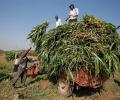
Lauding the farm sector for demonstrating resilience during the pandemic, the Economic Survey on Friday suggested the government to see farm sector as a "modern business enterprise" for which "urgent reforms" are required to enable sustainable and consistent growth. India's agricultural sector has shown its resilience amid the adversities of COVID-19 induced lockdowns, the Survey noted. The agriculture and allied activities were the sole bright spot amid the slide in GDP performance of other sectors, clocking a growth rate of 3.4 per cent at constant prices during 2020-21, it added. According to the Survey, the farm sector has got "renewed thrust" due to various measures on credit, market reforms and food processing under the Aatmanirbhar Bharat announcements.

The United States State Department has authorised a Foreign Military Sales (FMS) case for Turkiye to purchase AIM-120C-8 Advanced Medium-Range Air-to-Air Missiles and related elements of logistics and program support for an estimated cost of $22 million.

The Economic Survey seems convinced that 2019-2020 saw the bottom of the economic cycle, points out Abheek Barua, chief economist, HDFC Bank.
There are few concerns in India's growth story.
As the poverty rates in the country declined below 5 percent in 2024, a research study by State Bank of India also highlighted that the extreme poverty in the country has been reduced to minimal.
Sanjay Malhotra takes charge as the 26th RBI governor at a time when headline retail inflation has shot up to 6.2%.
'The Election Commission's involvement in the avoidable SIR controversy has carried a message down to the last voter -- who just does not like it,' observes N Sathiya Moorthy.

'There's a misconception that all Rs 1 lakh crore will be spent immediately, leading to higher consumption of FMCG goods, travel, and vehicle purchases.' 'While some of this money will go toward consumption, not all of it will.' 'The impact depends on where people deploy their savings.'
The BJP's surprise announcement of a caste census in the next census has sparked political debate, particularly in Bihar where the issue of backward empowerment holds significant electoral weight. The move is seen as a strategic maneuver by the ruling party to counter opposition efforts to mobilize support among disadvantaged sections of society. The decision is also viewed as a recognition of the growing influence of OBC politics in India.

'There were deep discussions within the Sangh Parivar before this decision was made.' 'They were convinced, and only then did the Modi government proceed with the caste census.'

It also advocated adoption of technology platforms and innovative models.

Adarsh Kumar, the son of a farmer and a Class 12 student from rural Bihar, is on a mission to build one of India's largest free skill development movements, powered only with a laptop, free Internet and his relentless determination.
The message from Sunday's event will undoubtedly reverberate globally. It's a landmark occasion that will be remembered for generations and will inspire many other states to introduce the story of Rajendra Chola into school curricula, says Tarun Vijay.
